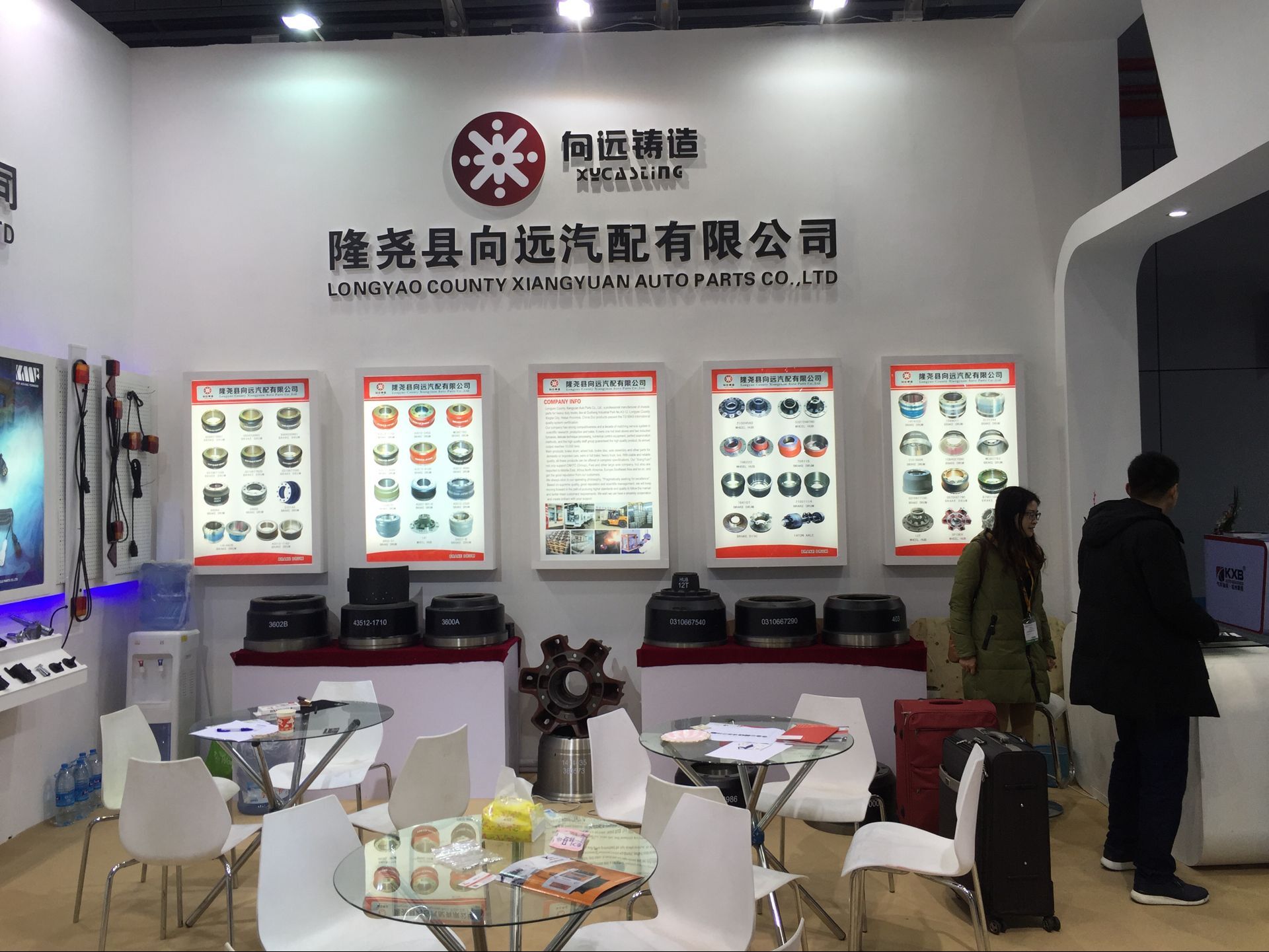
Hot key words:Brake drum Hub Brake pads
CONTACT:
Manager Lv:0086-13831914368ADDRESS:
Company Add:Workshop 6, Xingye Road, Economic Development Zone, Longyao County,Xingtai City,Hebei ProvinceAutomobile brake drum is an important functional part of the automobile, is also the most important part to measure the safety performance of the automobile, but also the first part to be inspected in the daily maintenance, the relevant data show that the brake drum failure mainly has five forms: cracking, cracking, falling bottom, excessive wear, abnormal wear. One of the main causes of the first two forms of fracture is discussed below -- thermal fatigue fracture caused by high temperature chilling.
Sampling plan and inspection basis
I. Sampling plan
Source of the brake drum in the sample of the product is the replacement for the garage scrap products, from shijiazhuang, the city of chaff, and positive definite three areas of six repair shop purchase 30 samples, the choice of the garage are relatively large, the vehicles involved sort is more, the product model is more, and the repair shop service object is all over the country, so the purchase of samples have certain representativeness.
The location and degree of damage of this sample are different, which enables the analyst to have a more comprehensive grasp of the quality risk points of this sample.
Samples from the sample appearance analysis, most of the damage location of friction surface crack, and brake drum causes of crack is, vehicles running down the hill too long can produce high temperature brake drum, if wade, immediately after the downhill brake drum with water and a sharp contraction, so the friction brake drum surface cracks along axis direction, this kind of crack extension with continue to brake, the brake drum rupture. Some brake drums in the warranty found that the friction surface shows a piece of shiny speckle, which is the brake drums in high temperature and water caused by.
Ii. Test basis
This analysis is mainly based on the standards of GB/T 7216-2009 Gray Cast iron Metallography, GB/T13298-2015 Metal Microstructure Inspection Method, GB/T9439-2010 Gray Cast Iron, JB/T7711-2007 Heat Treatment of Gray Cast Iron, etc.
The cause and proof of brake drum cracking and cracking
Five brake drums with cracking and cracking characteristics were selected from 30 brake drums found in the garage, and the samples were taken at the crack density for experimental observation. The sampling method is as follows: cut an ingot 2cm square on the working surface where the drum wall is in contact with the brake lining (no high temperature is generated during cutting to prevent phase transition), mark the inner and outer wall of the ingot and number the corresponding sample. After making the sample, it was metallographically polished and corroded (corroded for 15 seconds at room temperature in 5% alcohol nitrate solution) to obtain the structure as shown in the figure below.
After preliminary observation of the surface of the corroded samples, it is not difficult to find that each sample has one or two dark patches, and the patches are usually perpendicular to the crack extension direction and parallel to the direction of brake friction, and often in the middle of the crack. Therefore, it is not difficult to guess that the dark patches are phase change tissues formed by local high temperature and rapid cooling caused by uneven heat production during brake drum operation, and the cracks first arise from the central position of phase change and extend perpendicular to both sides of the direction of brake friction, extending to the end of the tissues without phase change. To prove the above conjecture, the author observed the five corroded samples under a 400x metallographic microscope and took metallographic photos as follows:
Through these figures, it is not difficult to find that the local dark parts of the five test blocks all went through high temperature (above 727℃) and underwent quenching phase transition, and finally formed tempered Soxhlet or tempered troostite. Because the structure is too fine, it is difficult to distinguish the boundary between ferrite and cementite under the light microscope, so only the dark structure can be observed. Subsequently, the author made 100 times of microscopic observation and photographs of the crack, and selected several typical pictures listed as follows.
Through observation of the five samples of crack can be found: the extending direction of crack is straight, crack extension in the direction of the graphite and almost in the same direction from one to another graphite, graphite even in dendritic, have obvious characteristics of brittle fracture but not when the crack extends to the phase change of the whole area crack to buckle, and ending at most and crack as a whole to show large Angle edge of one of the graphite. Therefore, it can be inferred that the local part of the failed brake drum is cooled at a high speed while reaching the phase transition temperature, which makes the matrix of the failed brake drum become hardened. The brittleness large and contains a lot of residual phase transformation stress, when hit by frequent complex stress (due to the braking action of the normal compressive stress and tangential friction stress and brake thermal stress produced by heating effect after a period of time, the site of some of the stress concentration place (carbide sharp corners or the place such as the tip of the graphite) is greater than the synthetic stress fracture strength of the particle material, as the initial crack initiation. As the extension of crack and extended to a certain plastic without phase transformation matrix organization, matrix by plastic deformation, relaxation of stress, coupled with the tip of the crack due to plastic deformation, the deformation reinforcement, so the extension of crack path twists and turns, the degree of stress concentration at the same time as the bending of the path and slowly lose eventually vanish into the matrix cracks. In order to further verify this inference, the following thermal fatigue tests were carried out to simulate its working conditions.
High temperature cooling and thermal fatigue test of brake drum
A, sample preparation
A square ingot with a wall thickness of 1.5cm by 1.5cm was cut from the flange bottom of the failed brake drum which was not affected by the high temperature phase transition, and was ground away by the layer affected by the residual stress of the line cutting surface (note that no new residual stress was generated during grinding). Finally, all surface roughness of the ingot was treated to ≤3.2 m.
Ii. Test operation
The specimen was heated to 880℃ for one minute, then taken out and quickly put into 20℃ water for cooling. Such cyclic operation was performed until the crack was observed by the naked eye, and then blow-dried for metallographic observation.
Iii. Test results
After tests, cracks visible to the naked eye appeared in the 30 test blocks during the high temperature and chilling for 31, 14, 35, 28, 41, 29, 36, 28, 30, 26, 28, 32, 33, 37, 29, 34, 27, 33, 28, 28, 30, 33, 36, 27, 30, 32, 40, 29 and 30 times successively. The crack morphology is consistent with the failure position of brake drum.
Four, conclusion
Thermal fatigue fracture caused by high temperature chilling is indeed one of the main causes of brake drum cracking and cracking.